Showing posts with label Theory of loose parts. Show all posts

Sunday, November 6, 2016

Ramayana - An Art Inquiry


The Hundred Languages

No way. The hundred is there.
The child
is made of one hundred.
The child has
a hundred languages
a hundred hands
a hundred thoughts
a hundred ways of thinking
of playing, of speaking.
A hundred always a hundred
ways of listening
of marveling, of loving
a hundred joys
for singing and understanding
a hundred worlds
to discover
a hundred worlds
to invent
a hundred worlds
to dream.
The child has
a hundred languages
(and a hundred hundred hundred more)
…
 — Loris Malaguzzi
   Founder of Reggio Emilia Approach

Please read the rest of the poem to understand the point driven.

I admire this poem a lot. How true is each word! Don't you believe that a child has  hundred languages? I do! I know at least a dozen that Sid and Nidhi use to express their thoughts.

Here is their recent inquiry as an example.
What do kids do when they listen to a story? They listen mesmerized, recall the facts, retell the newly acquired story to every stranger they meet. Familiar? Because that is what we observe. But their minds are constantly churning. They express the understanding in many more ways which we don't observe or don't care about.

During the Dussera festival, we started story telling of Ramayana a little each day. Every new episode was received in awe during their lunch and dinner times. Thus started Sid’s obsession with Rama. He used many mediums to express his thoughts on Rama. Each medium is already known to him. So, what’s new? I presented new challenges in each medium which he worked through very beautifully. 


Sculpting:
Sid declared ,”I want to make my own Rama doll”. I presented to him some air dry clay. They have already created sculptures using play doh, modeling clay, air-dry clay etc. So, what's new?

The Challenge : Try the sculptures in different postures.
The work: Sid first tried standing sculptures of the main characters-Rama, Seetha and Lakshman. He learnt the new trick of using a skewer to balance the posture.
Next, he worked very hard to make sitting sculptures with crossed legs. Here are the finished works. Unfortunately, I could not find the sitting sculpture pictures. They proudly played with these self made dolls for quite some time.
Standing Rama and Seetha

Illustration:
Sid started illustrating the episode he heard each day. He tried various art mediums - sketching, crayons, oil pastels, watercolor. He has been drawing for each inquiry. So what’s new?
The Challenge: I describe to him a scene from the story and challenge him to draw it the ways he imagines.

The work:
 He has not seen a video or picture of Ramayan till now. All paintings are his own expressions from his mind influenced by the narrative of our story. It was interesting to see a perspective of a 4 year old who has not been visually influenced. He drew many versions of each scene, refining his work with every description of the scene.
He has now at least 50 pages of illustrations covering the complete Ramayan known to him.

Here is a short video compilation of some of his works.

Shadow Puppetry:

Sid once drew dark images of his main characters and claimed them to be shadow puppets. So I set a provocation with required materials to make shadow puppets. They drew their characters on black construction paper and I helped them cut them. The shadow puppets were born.

They have been making puppets for long. So what’s new? Not a thing. This is an open ended play that lets their imagination run wild. I loved some learning that happened. Mostly, cooperative team play. Some observations such as, how Rama grows to become a giant when the puppet is near the light source. Most fun is when characters of Ramayana are singing Twinkle, twinkle little star!

Main cast of the Ramayana story

Rama and Seetha walking to forest

Enacting Ramayana through Shadows


Loose parts play:

Sid also made characters with pattern blocks. They frequently engage in loose parts creation. So what’s new?

The challenge: After Sid made the main characters with pattern blocks, he enhanced his scene by adding ground and sky. 

Seth,Rama,Flying Hanuman,Soorpanaka and Raavana

Suddenly, he moved the sticks for ground and noted, “Look Mom! It looks like Soorpanaka is skipping. All others are going to take turns.”

Soorpanaka skipping with jump rope


I challenged him to change the scene such that Rama and Seetha are skipping without moving them. Here is the solution that he worked out.


gh
Rama skipping with jump rope

Seetha and Soorpanaka enjoying skipping


There has been a lot of other learning. 

Writing: Describing the scenes or naming the characters on their own.
Narrating / Story telling: They repeatedly retold the story, role played, pretend played. This helped learn a lot of vocabulary.
Mathematics: A lot of Math was involved.

For example,  During the loose parts play, Sid suddenly exclaimed, “Mom! There are ten units and four units of heads in this!” 
“ And what is ten units?” , I queried. 
“Ten units is One Ten!”, replied Nidhi.
“Yes, there are One ten and four units of heads in this scene.”, revised Sid.
“One ten and four units is 14!”, shouted Nidhi.

We rechecked. There are 14 heads in total for Raavan, Rama, Seetha, Soorpanaka and Hanuman.


Who would have thoughts kids can learn place value system with Ramayana!

Most of all, FUN!

Wednesday, July 6, 2016

Encouraging creativity with TinkerBox

"To invent you need a good imagination and a pile of junk." - Thomas Edison
Have you ever noticed what kids do when they are given a pile of junk? Junk, not toys. Just Junk. Surprise!  They start to tinker with the pile in million ways we never would have thought about. This tinkering encourages them to think critically, solve problems, and most importantly stay creative.

What is tinkering?
To quote The Exploratorium,  "tinkering is thinking with your hands and learning through doing. It’s slowing down and getting curious about the mechanics and mysteries of the everyday stuff around you."

What is a Tinker box?
 A tinkerbox (also known as Tinker tray) at our house, is a simple divided box with various loose parts. You can read more about loose parts play and creativity in a post written a few months back.  So, when in mood to play with something new or just tinker with something, tinker box is our go to resource.

A divided box containing loose parts
The Tinker Box

What is in our tinker box?
1. Rings and Sticks
2. Googly eyes - adds a character to anything it is attached to instantly.
3. Straws
4. Pipe cleaners/chenille sticks or wires
5. buttons and beads
6. Popsicle sticks/ craft sticks
7. Feathers
8. Push Pins
9. Yarn/String
10. Pattern blocks/shapes
11. Bonding materials such as tapes,glue and rubber bands
12. cardboard tubes and recyclables

Basically, a tinker box can comprise of any number of familiar, interesting materials left to be used in unfamiliar ways.

If tinker box contains craft items then what is the difference between tinkering and crafting for preschoolers?

Both tinkering and crafting are about making something. But in tinkering, you do not follow stepwise instructions to achieve a neat end result. When tinkering, the end result may reveal as you go.

How to initiate and maintain interest in tinkering?

If a new material is added to tinkerbox or tinkerbox is just being introduced, I would set up provocations displaying a few ways the materials can be used creatively.
A small provocation setup by me
To sustain kids' interest, I add other open ended materials such as play dough, paper and coloring materials etc.
I also rotate materials according to the kids current interest if the box goes unnoticed for some time.Say, the kids are currently interested in cars, adding materials for wheels (like bottle caps) and axles (sticks or skewers) can help bring their interest back to tinkering.


So what do Sid and Nidhi do with their tinkerbox?


Creative Expression
Sid and Nidhi enjoy using loose parts in the tinker box for expressing their creative thoughts, for story telling and to retell their experiences.

Here is Sid's depiction of a juggler after visiting a juggling show.
A juggler balancing on a ring by Sid

 Here is a story told by Nidhi about two little girls trying to find their way home. She also documented her representation as drawing on paper.

Girls walking on road by Nidhi


For Pretend/Imaginative play:

A simple tinkering of cardstock paper with couple of pipe cleaners can transform them into little prince and princess.

Prince and Cinderella with their self made crowns

Add a pair of googly eyes and you get an instant pretend companion.

Look! My little car is drinking juice(petrol)

Here is a short video of Sid singing with a  Banjo built by him and Nidhi listening to the song with her pretend headphones and mike.


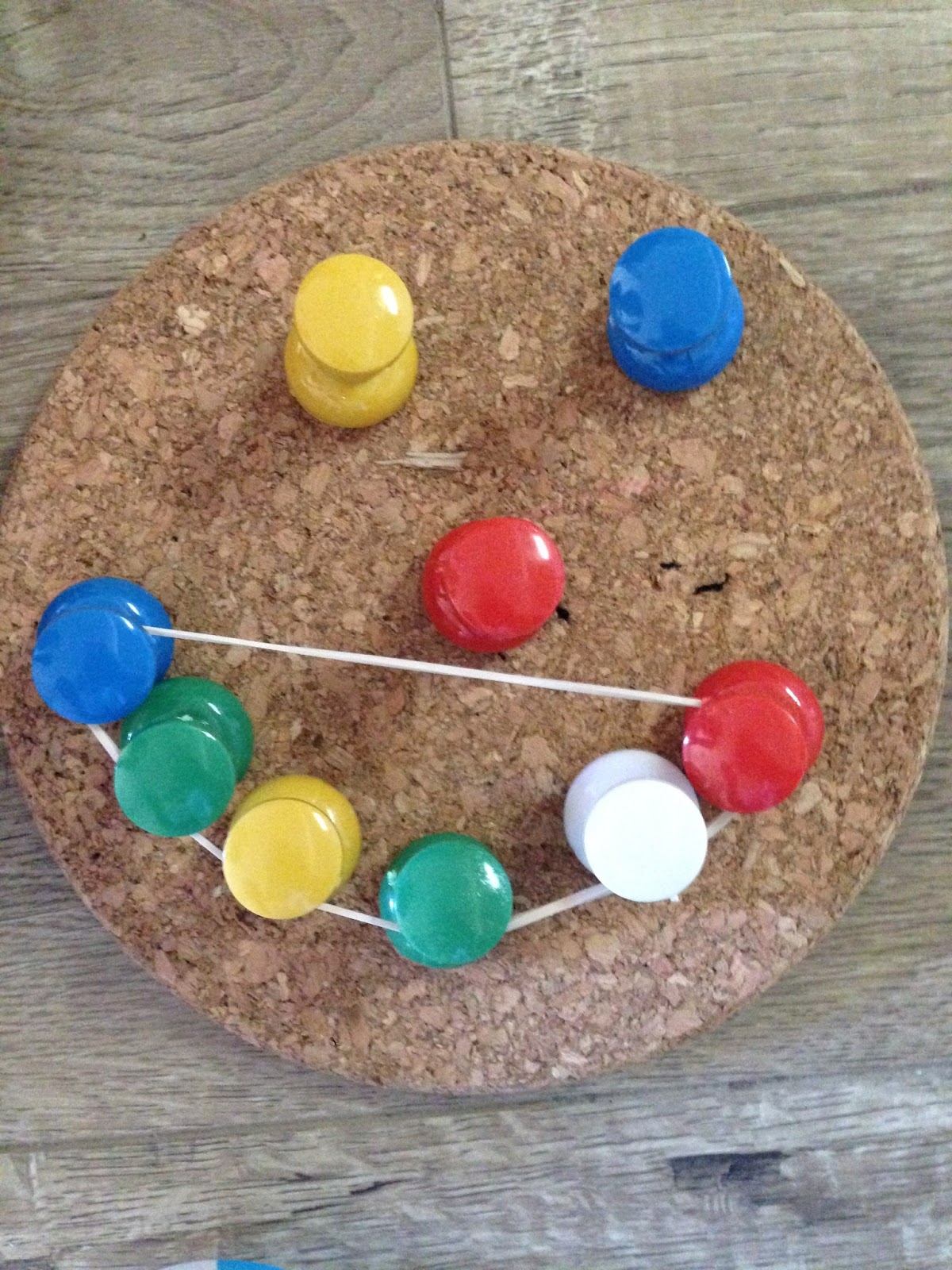
Here is Sid playing a banjo made with cork board, a train track, push pins and rubber bands.
Sid playing a DIY banjo

For Preschool Math and literacy learning:

Though this way of using loose parts may not contribute towards tinkering, it reinforces versatility of tinker box.
Nidhi building alphabets with popsicle sticks

Sorting buttons by colors
Preschool Engineering:
Nidhi trying out a pulley system

Piggy's straw house
Piggy's straw house


Art projects:
Often just having fun results in amazing art products like this mobile made by Nidhi hanging elegantly in our room.
A mobile made of loose parts from the tinker box


Another hanging mobile in making

And more importantly having fun!


A happy face with pins and rubber band
Do you have a tinker box for your preschooler? What's in it? Share your thoughts.

“The creative process in tinkering, I believe, lets your mind escape from the day-in and day-out of life. And I think it's so important, when we’re building something, to escape.” – Scott Weaver


Wednesday, December 16, 2015

Tuesday, November 10, 2015

Loose parts play and creativity


"Creativity is the key to success in the future, and primary education is where teachers can bring creativity in children at that level." - Beloved Dr. A.P.J. Abdul Kalam

"Our task regarding creativity, is to help children climb their own mountains, as high as possible. No one can do more" - Loris Malaguzzi

Well, now with these quotes we have established that creativity is important in a child's life, and it is our responsibility to help him/her.

But, how can we help them get creative?
Let them PLAY.
"Almost all creativity involves purposeful play" said Abrahm Maslow.

Just play?
 Yes, just open ended play using open ended materials.

What are open ended materials?
Open ended materials are those which young children use in any way they like within safety limits. There is no “one way” of playing with them. Some examples are crayons, paint, clay, play dough etc.

What are loose parts?
 Loose parts are materials that can be moved, carried, combined, redesigned, lined up, and taken apart and put back together in multiple ways.
For example, twigs, seeds, buckets, buttons, fabric, stones etc.
They can be natural or synthetic.

Looks simple right? It's what our kids play with day in and day out. Here I’m sharing a few of Sid and Nidhi's creations with loose parts. We can see their perception and understanding of some objects (primarily construction vehicles for Sid). 
A flower


A Digger

A Dandelion

A front loader with back hoe
A loader

A Firetruck

A coconut tree

A crane

Tally marks
Scissors (made from bridge parts of wooden train tracks) 


Loris Malaguzzi said in The Hundred languages of children “They(children) are autonomously capable of making meaning from their everyday life experiences through mental acts involving planning, coordination of ideas and abstraction..."

How true!!