Showing posts with label Patterns. Show all posts

Friday, November 27, 2015

Integrating Music and Pattern Inquiries

" Even the youngest children have the potential to inherently respond to music and the mathematical constructs it contains."

I recently came across this article on The Patterns of Music which talks about importance of exposure to music at early years to support developing mathematical concepts in children from infancy to 5 years of age. Coincidentally the twins' teacher also suggested to get them a xylophone at home to practice music. So I did and took this as an opportunity to let them make the connection between music and pattern inquiries.

Xylophone exploration:
    I presented the xylophone with color coded music sheet for playing "Twinkle Twinkle little star". To my surprise, Shrini very quickly caught on the concept of playing according to the notes. Very soon she started singing along "Red,Red, Blue,blue, Indigo,Indigo,Blue" to the tune of Twinkle Twinkle little star. Then she observed "Look Mom, it is like AB pattern 2 times".
Here is a short video of her playing the tune the first time.


She also observed that the xylophone had rainbow colors and decided to paint one by herself.

We are now planning to explore what patterns we can find in "Baa Baa black sheep". What fun!!

Sunday, November 1, 2015

Patterns Inquiry - Exploring AB patterns

When I searched for ideas to explore patterns with preschoolers I found many activities using objects in AB pattern and asking questions such as "what comes next?"
I feel such activities lack the big picture. I like these cute activities and they are useful for reinforcing the concept of patterns but not to introduce patterns. what would children think while doing them? My guess is that they are thinking "why do I have to use only these objects? Why do I have to even line them up? Why do I have to follow this particular pattern?" Do these cute activities have an answer for these queries?

These activities miss the big picture! The exploration should answer questions that will make sense to their little minds.

How can we introduce patterns? Through the world around us. Point out when you encounter patterns in real life. Here are few examples
Up/down motion of swings or teeter totter
Opening and closing a faucet/ door
Tick tock of clock...

This thought process got me the idea of utilizing Sid and Shrini's excitement about Halloween celebration. Everyday this week they have woken up with anticipation of it being Halloween.
So I set up a simple provocation.

Simple Provocation - Day and Night picture cards

I laid out a few photo cards of day and night images. The idea was to let them predict Halloween day. I setup the provocation on Thursday.


First, the kids sorted the day and night pictures.  I asked some questions to assess their prior knowledge such as Why do you think this is day/ night? Why are nights dark? What difference do you notice in the sky?
Soon I figured out that they were confusing time of day with day of week. So I simplified the questions.
What comes after day?
What comes after night?
Quickly they figured that day and night alternate forming an AB pattern.
Now they look out for patterns almost everywhere. This evening Shrini coughed in rhythmic hi/lo fashion and exclaimed "See mom! My cough was like ABAB!" :)
Here is a short video of Shrini working with the picture cards.

Can you share your ideas for real life pattern exploration?

Monday, October 19, 2015

Patterns inquiry

Shrini was stringing pony beads to make necklace for herself. I thought this might be a good opportunity to practice patterns.
Me : Can you make a pattern?
Shrini: This is a pattern.
Me : These colors seem pretty random to me. Let us do Pink, white, green, pink,white, green. OK?
She obliged a couple of times and then resumed with random order.
Me : Don't you want to continue with the pattern?
Shrini: This IS a pattern, mom. See, Stripes!

Do you see her stripes pattern? :)


Simple Provocation : Rings and Sticks

The kids notice patterns around them all the time. It is mostly identification of a particular pattern like stripes, zigzag or spiral. But the concept  that pattern is anything that repeats or follows a definite rule is not understood by them.
I'm curious to see if they will discover it on their own, given the right kind of provocations.
So, I set up a tray with some colorful rings and sticks from a Hape toy and presented them a few images of patterns.
Sid tried to copy and build the art with concentric circles. He missed blue rings that were in the picture and didn't want to proceed further. So I suggested him to try zig zag. Immediately he found that zig zag has triangles in them. But did he notice that the triangles repeated? Alas, no!
The sticks then turned into alphabets, musical instruments etc and the activity came to an end.

Here is a short video of the kids working with the provocation set up.

Saturday, October 17, 2015

Pattern Inquiry - Patterns through Art Exploration

   Mathematics is sometimes called "The Science of Pattern". All week long we have been talking about recognizing patterns whenever possible. We tried to identify the pattern core in zigzags and stripes and tried to build them with Rings and Sticks.

    We created AB, AAB, ABC patterns with beads, made predictions of what comes next etc. But I felt like I could not take the inquiry any further. The interest seemed to be diminishing and I thought of setting this inquiry aside for later time.

    Today Shrini was working with watercolor and suddenly proclaimed, "Hey Mom! Look at my zigzag painting!". I rushed to look at the painting and found a thick, continuous sharp little red mountains. Amazing! She has painted a zigzag line just from memory without any provocation.
For kids this young, art and early writing skills are one and same. This ability to hold a pattern in mind and putting it on paper is a good thinking skill that definitely needs encouragement.

     Realizing the opportunity I wanted to take it further. So followed a few inquiries.

Can you draw stripes?
How about spots? 
Does one dot make a Spots pattern? 
Spots, zigzag and stripes pattern


I wanted to challenge her with some complex patterns.

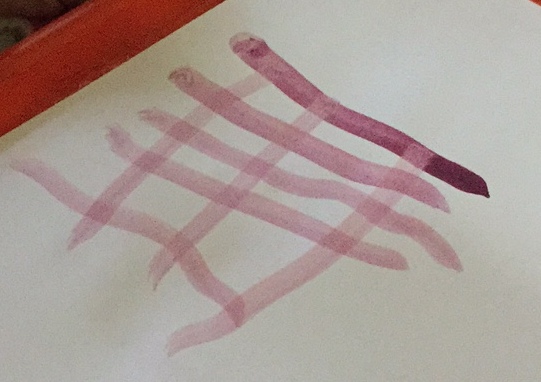
Can you draw checkered pattern?
She was stumped by this question. So I brought out my iPad to show her some checkered designs for inspiration.

"Do I draw squares?" she asked.
Can you try checkered pattern with horizontal and vertical stripes?
Inspirational pattern
Shrini's checkered pattern


Can you try spiral?
She drew a few concentric circles and soon recognized spiral was bit different. After I explained her the difference she tried drawing a spiral.

Inspirational pattern
Shrini's spiral

She wanted more challenge.
Can you draw a wave pattern?
Can you draw a pattern with triangles? 

Again, I showed a design for inspiration.
She tried her level best to copy the pattern.
Here is a short video of her trying to draw these patterns.


Loris Malaguzzi writes in her poem "The Hundred languages of Children"

The Child is made of 
one hundred
A hundred languages
A hundred hands
A hundred thoughts
A hundred ways of thinking

Of playing, of speaking.

Today I got to experience one of Shrini's language - Art to communicate her understanding of Math!